| Minimum Eligibility |
Workplace age, licensing, and site requirements vary by jurisdiction and employer. Many industrial workplaces require operators to be at least 18 for higher-risk duties. |
Confirm local legal requirements, employer rules, equipment restrictions, and any required medical or occupational documentation before training. |
Documents verified |
Never operate equipment without the authorization, training, and supervision required for the specific machine and worksite. |
| Basic Education and Communication |
Functional reading, writing, basic arithmetic, and the ability to understand safety signs, manuals, alarms, and radio instructions. |
Read load charts, identify warning symbols, interpret measurements, and communicate clearly with spotters and site personnel. |
Instructions understood |
Misunderstood signals or unclear radio communication can cause collisions, struck-by incidents, or load instability. |
| Equipment Familiarization |
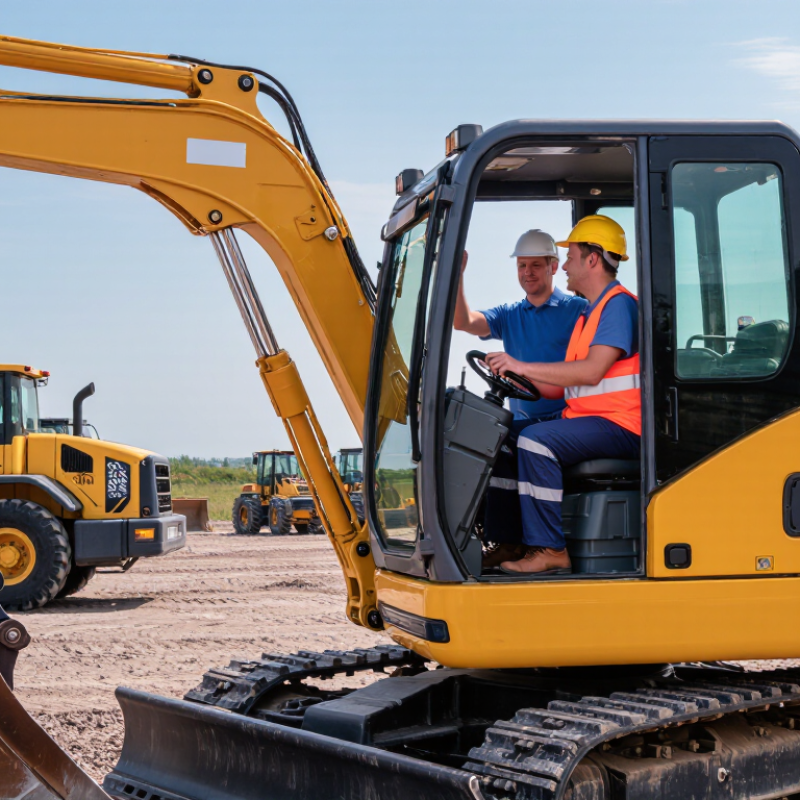
Training should be specific to the machine type, model, controls, attachments, and operating environment. |
Locate controls, emergency stops, seat belts, alarms, mirrors, lights, access points, fluid checks, and manufacturer safety labels. |
Pre-start inspection completed |
Do not assume that experience on one machine transfers automatically to another machine or attachment. |
| Hazard Recognition |
Before operation, identify traffic routes, pedestrians, blind spots, overhead lines, underground services, slopes, edges, unstable ground, and weather hazards. |
Complete a site walkaround and explain how the work area will be isolated, controlled, and monitored. |
Hazards identified |
Maintain a safe exclusion zone and stop work when visibility, ground conditions, or communication becomes inadequate. |
| Safety Knowledge |
Core topics normally include seat-belt use, rollover prevention, lockout procedures, safe access, three-point contact, and emergency response. |
Explain why the machine must be parked securely, attachments lowered, controls neutralized, and energy sources isolated before servicing. |
Safety questions passed |
Never bypass guards, alarms, interlocks, or safety devices, and never carry passengers unless the equipment is designed for them. |
| Physical Readiness |
Operators need sufficient vision, hearing, reaction time, balance, coordination, and mobility for safe entry, exit, and control use. |
Enter and exit using handholds and steps, maintain posture, operate controls smoothly, and detect alarms or nearby activity. |
Functional ability confirmed |
Fatigue, illness, alcohol, drugs, or medication effects that impair alertness or coordination make operation unsafe. |
| Practical Training |
Use a structured progression: instructor demonstration, supervised practice, controlled exercises, and workplace-specific evaluation. |
Practice starting, stopping, steering, reversing, parking, attachment use, loading, grading, lifting limits, and emergency procedures. |
Skills demonstrated |
Begin in an open, controlled area at low speed and increase task complexity only after consistent control is shown. |
| Load and Stability Awareness |
Safe capacity depends on machine configuration, attachment, load center, ground conditions, slope, and manufacturer limits. |
Use rated capacity information, keep loads stable, avoid excessive speed, and understand how raised loads affect machine stability. |
Capacity limits explained |
Never exceed rated capacity or travel with a load positioned in a way that reduces stability or visibility. |
| Supervised Operation |
New operators should work under direct supervision until they can perform routine tasks safely and consistently. |
Follow the site plan, respond correctly to signals, maintain safe clearances, and stop when conditions change. |
Supervisor approval |
Supervision should be closer for unfamiliar equipment, congested areas, lifting work, slopes, and limited-visibility operations. |
| Final Competency Evaluation |
Assessment should combine a knowledge test, a pre-use inspection, and a practical performance evaluation. |
Complete the assigned task without unsafe shortcuts, explain hazards, use required protective equipment, and shut down correctly. |
Competent for assigned tasks |
Qualification should be limited to the equipment, attachments, tasks, and conditions actually evaluated. |
| Continued Improvement |
Refresher training is appropriate after an incident, unsafe observation, extended absence, equipment change, or major procedure change. |
Review near misses, update site knowledge, practice emergency actions, and repeat evaluations when performance declines. |
Records maintained |
Competence is not permanent; changing equipment, terrain, weather, and work methods require ongoing attention. |